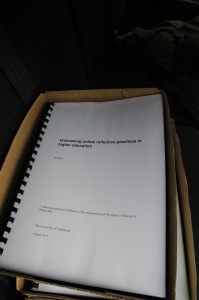
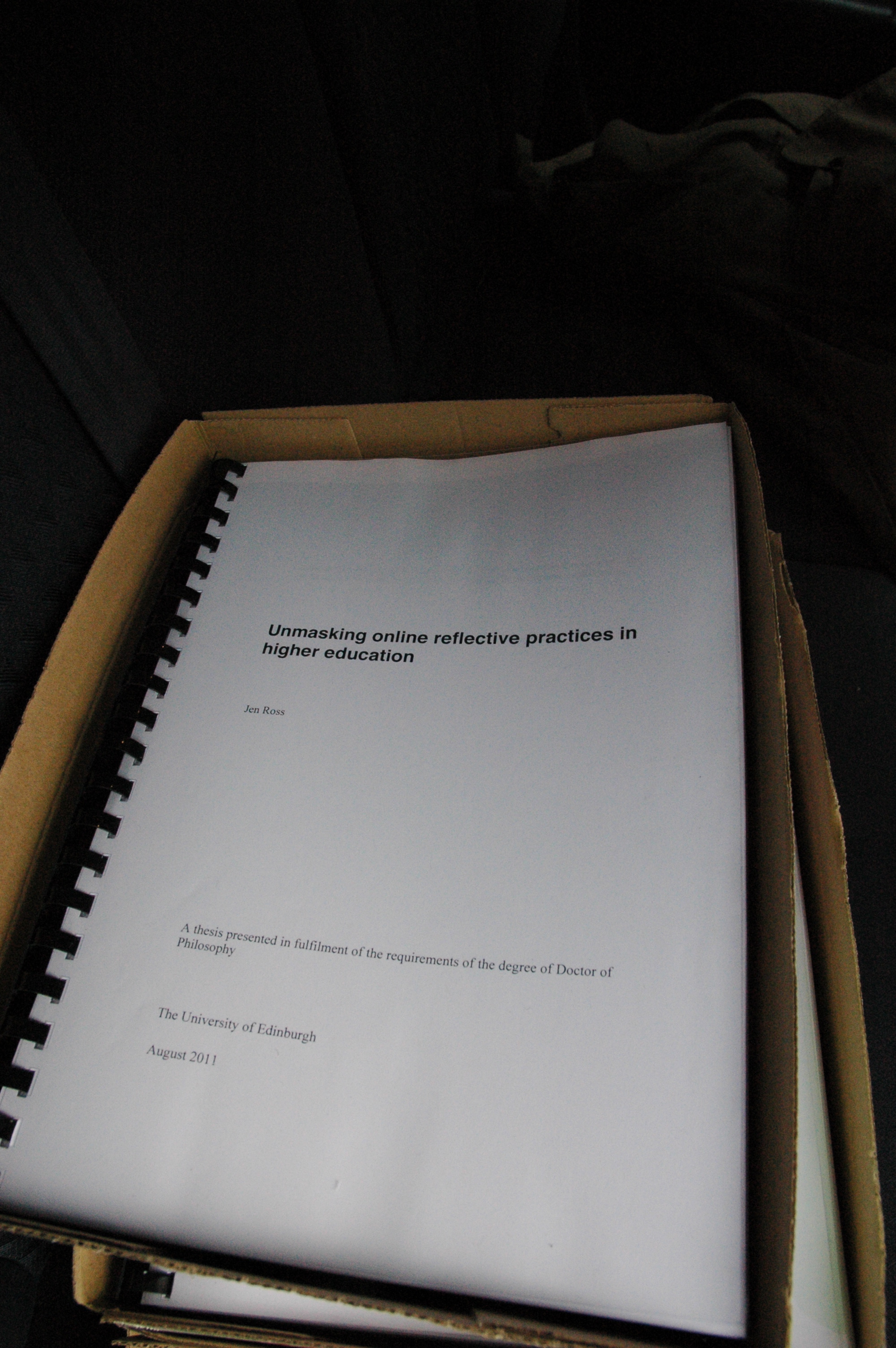
 I’m really happy to say that I submitted my phd thesis this afternoon. I’m pretty much out of words, but here’s the abstract. I’ll write more soon – perhaps a small series of blog posts about the research and where it might go from here.
My viva is on 11 October, so the blog posts may have to wait til after that!
Unmasking online reflective practices in higher education
Online reflective practices that are high-stakes – summatively assessed, or used as evidence for progression or membership in a professional body – are increasingly prevalent in higher education, especially in professional and vocational programmes. A combination of factors is influencing their emergence: an e-learning agenda that promises efficiency and ubiquity; a proliferation of employability, transferable skills and personal development planning policies; a culture of surveillance which prizes visibility and transparency; and teacher preference for what are seen as empowering pedagogies.
This thesis analyses qualitative interview data to explore how students and teachers negotiate issues of audience, performance and authenticity in their high-stakes online reflective practices. Using mask metaphors, and taking a post-structuralist and specifically Foucauldian perspective, the work examines themes of performance, trace, disguise, protection, discipline and transformation. The central argument is that the effects of both compulsory reflection, and writing online, destabilise and ultimately challenge the humanist ideals on which reflective practices are based: those of a ‘true self’ which can be revealed, understood, recorded, improved or liberated through the process of writing about thoughts and experiences.
Rather than revealing and developing the ‘true self’, reflecting online and for assessment produces fragmented, performing, cautious, strategic selves. As a result, it offers an opportunity to work critically with an awareness of audience, genres of writing and shifting subjectivity. This is rarely, if ever, explicitly the goal of such practices. Instead, online reflective practices are imported wholesale from their offline counterparts without acknowledgement of the difference that being online makes, and issues of power in high-stakes reflection are disguised or ignored. Discourses of authentic self-knowledge, personal and professional development, and transformative learning are not appropriate to the nature of high-stakes online reflection. The combination creates passivity, anxiety and calculation, it normalises surveillance, and it produces rituals of confession and compliance. More critical approaches to high-stakes online reflection, which take into account addressivity, experimentation and digitality, are proposed.


 I’ll be giving at talk at the