A few things to highlight from the last academic year, as we head into a new one.
Fiction and futures
I did some writing about the use of speculative fiction this year. First – and it was online in 2025, but the full special issue, including the great editorial from the editors Stefan Hrastinski, Eamon Costello and Lina Rahm has just been published – a paper about using speculative pedagogies (in this case, ‘stories from the future’ with postgraduate students on my Culture, Heritage and Learning Futures course):
Ross, J. (2026). Stories from the future of lifelong learning: fiction, technology and speculative pedagogies. Learning, Media and Technology, 51/3. Special Issue: Fiction in Learning, Media and Technology Research. https://www.tandfonline.com/doi/full/10.1080/17439884.2025.2591697 .
The paper analyses fictions created by students, and argues that argues that bringing heritage thinking together with speculative fiction-writing can help unsettle the landscape of digital futures.
Second, Siân Bayne and I wrote a new AI scenario and micro-fiction for Stefan Hrastinski’s book, Education Fiction:
Bayne, S. and Ross, J. (2026). Crafting hopeful AI futures for education. In Hrastinski (S) (ed) Education Fiction. Routledge. https://doi.org/10.4324/9781003646563-6
This builds on our Higher Education Futures resource, and explores the possibilities of what Hayles describes as “technosymbiosis” for hopeful AI education futures.
I also used speculative fiction writing in a workshop for James Lamb’s Future Learning Spaces event in May 2026 in Edinburgh – stay tuned for more on the work on “privacy futures” that this was part of (and that I also talked about at the Postdigital Backlash conference in Zagreb in June, and in my inaugural lecture).
Responsible AI and the future of education
The AHRC-funded Bridging Responsible AI Divides project that was led from the Centre in 2024 (PI Judy Robertson) is still generating lots of discussions and outputs. I discussed it at the Anticipation conference in Milan in June, and will also be talking about it at a couple of online events in November. This year we published a chapter about the disconnect we observed between how young people perceived Generative AI (GenAI) and how they described education and schools, and what this might have to tell us about how we approach the use of futures work with young people.
Ross, J., Priyadharshini, E., Dyer, H., Atabey, A., Botta, C., Wilson, C. and Robertson, J. (2026). Imaginaries of responsible generative AI in secondary education. In W Holmes (ed), Handbook of Critical Studies of Artificial Intelligence and Education. Edward Elgar. https://www.elgaronline.com/edcollchap/book/9781035335879/chapter23.xml
In early 2026, Janja Komljenovic and I hosted Dr Araba Sey, supported by an EFI visiting fellowship award, to visit the Centre for Research in Digital Education for several weeks. We knew Araba through her work as Deputy Director at Research ICT Africa, and during her visit she gave a great seminar (recording available) on Connections and disconnections in technological visions for development in sub-Saharan Africa. We had an extended conversation during this period about the relationship of university digital infrastructure to social sustainability, and this led to our newly published commentary:
Here, we argue that higher education institutions need to pay as much attention to social sustainability in their procurement, development and use of technologies as they do to financial and environmental sustainability.
Making new digital futures for education
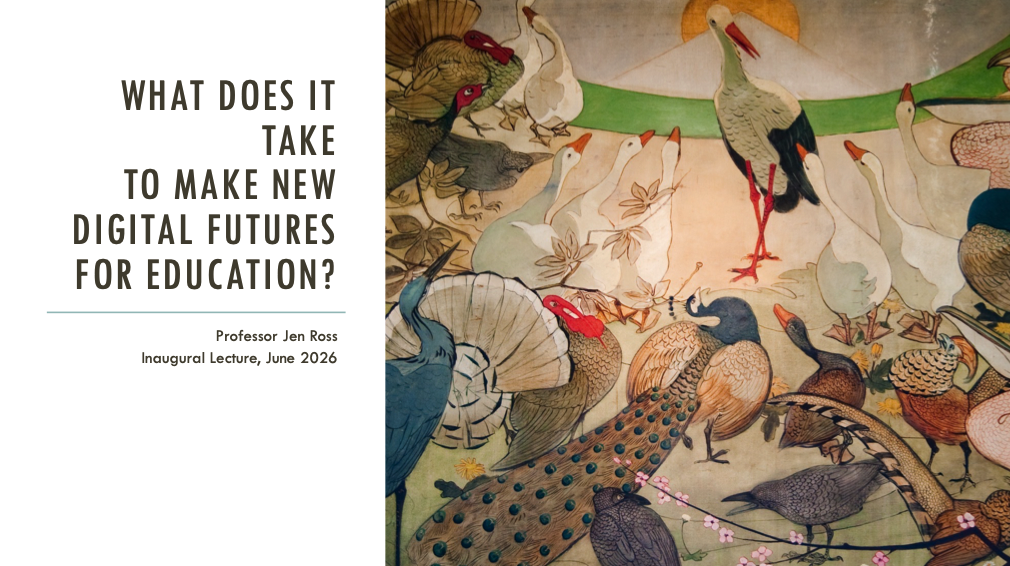
A highlight of my year was the opportunity to deliver my inaugural professorial lecture in front of colleagues, friends and family from across the world. The lecture was livestreamed and recorded, and the recording, slides and reference list is available online: