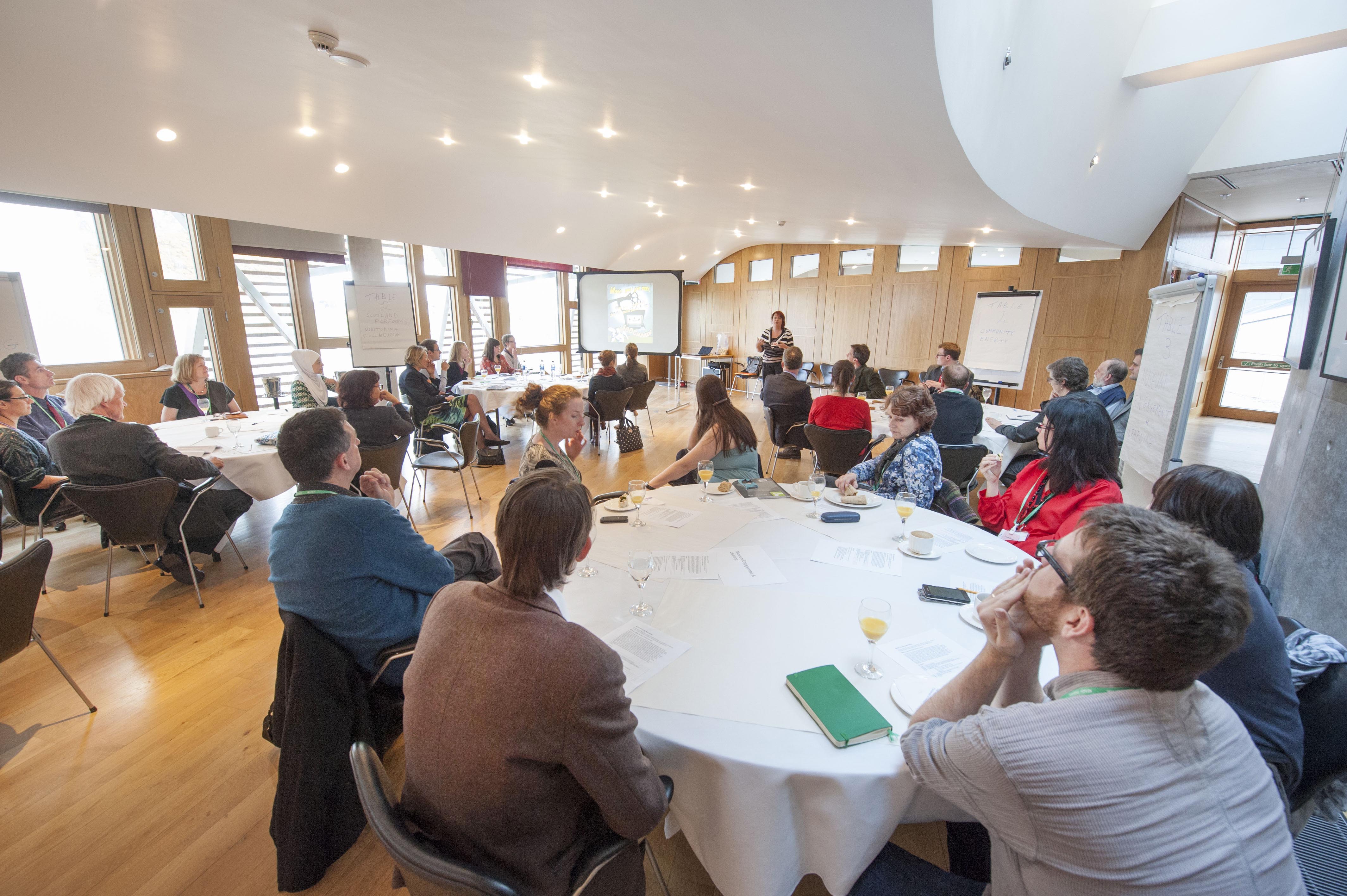
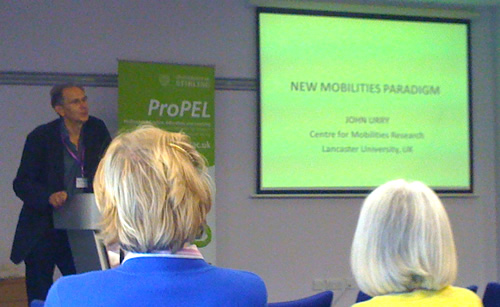
For the benefit of those who weren’t able to be there (and for my own use later), I liveblogged John Urry’s talk at the ProPEL conference in Stirling on 10 May 2012.
http://www.propel.stir.ac.uk/conference2012/speakers.php
New Mobilities Paradim, John Urry, Centre for Mobilities Research at Lancaster University.
John’s work has been about trying to mobilise the social sciences and develop a mobilities turn, to draw out how so many aspects of social life presuppose intermittent mobilities.
However, some of the empirical processes involved are problematic – will mobility as we understand it continue forever, or is it of a specific moment?
Tolstoy on “other contrivances” for transporting people – but “never able to commit anything but evil” in the process.
In 1800 people people in the US travelled 50 metres a day, by foot, horse and carriage. Now they travel 50km a day, mostly by car and air. But distance does not necessarily = time – a bit more than an hour a day gets you further than it used to.
World citizens move 23 billion km each year. This may quadruple by 2050.
How did this come about?
1839-41 – new and interdependent systems came into play, mainly in England and Scotland: telegram; national post; first railway age; first package tour (Thomas Cook); first Baedeker guide; first scheduled ocean steamship service; invention of photography. Forms of mass movement – not just technical, but coming together in a system. Systemness is particularly striking. A shift in the way in which environments were understood and experiences as land –> landscape (influenced by the tourist gaze).
The pleasures and uses of movement are interestingly interlinked.
Mobilities paradigm:
1. all social relationships involve diverse ‘connections’, some at a distance.
2. these stem from five interdependent ‘mobilities’: corporeal travel of people; movement of objects; imaginative travel; virtual travel; communicative travel (telephones, SMS, letters, etc.). These different forms of movement intersect.
3. physical travel involves lumpy, fragile, aged, gendered, racialised bodies.
4. on occasions and for specific periods of time face-to-face connections are made. There is still something significant about this. Five processes generate face-to-faceness: legal, formal obligations to attend; social obligations to meet and converse, often involving strong expectations of presence and attention (Goffman); obligations for co-presence to sign contracts, work on or with objects, written or visual texts; obligations to be in and experience a place directly; obligations to experience a live event.
5. many kinds of social practices that presuppose movement.
6. distance generates many problems for the sovereignty of states (groups on the move are particularly problematic)
7. part of what produces the heterogeneity of social life are material objects
8. crucial to these is the idea of affordances
9. the significance of systems for organising mobilities
10. mobility-systems are organised around processes that circulate people, objects and information at various spatial ranges and speeds
11. these various mobility-systems and routeways linger over time (canals)
12. mobility-systems are based on increasingly expert forms of knowledge
13. mobilities presuppose ‘immobilities’. Some people have to be immobile so other people can move around.
See journal “Mobilities” for examples of taking up and elaborations of these characteristics.
Some trends:
People’s lives are more spread out, so scheduled visits and meetings become more important (and meetings about meetings about meetings; a whole technology of meetings, diaries, calendars). Proliferation of locations, tech and systems to facilitate meetings.
Social networks are accomplishments, in process, weaving together material and social.
People are traveling further to accomplish their meetings.
Relational commitments are crucial to travel choices.
The greater the distances traveled, the longer the meetings will last.
Overall, “friendship miles” “family miles” “business miles” and so on become necessary in order to be a *good* social actor. These set up really strong obligations – “the gift of travel time” that shows your commitment to the people/group in question.
Zygmunt Bauman: “Mobility climbs to the rank of the uppermost among coveted values” – stratifying factor (Liquid Modernity) –> leads to the concept of “Network Capital” (Urry). In order to be good at networking, that presupposes an array of material and other resources, people to visit, movement capacities, ability to locate information, meeting places (including places en route), communication devices, time to manage and co-ordinate (especially when things go wrong). There is a large array of mobilities (many modalities) – much more complicated than govt statistics (business vs leisure) would indicate.
So: what are the future challenges for mobilities? 3 issues: Oil; climate change; China. These issues will be transformative of mobility systems.
OIL: Almost all mobility systems are dependent on one resource. 95% of transportation energy is oil-based. “almost free” resource transformed the US. Oil uniquely makes possible our mobilities. It also has made possible the movement of goods and the manufacture of goods (including food); heating. And it is running out. Continued growth of mobility processes becomes much more complicated.
CLIMATE CHANGE: increases in temperature make mobility systems more complicated and increase costs.
CHINA: China’s emissions are small per person, but growing rapidly; private cars are rising 22% each year and growing. 200 people/vehicle (1990) –> 48 (2004)
But is a reversal underway? A modest decline in US vehicle miles travelled in 2008. “Peak travel” – long term continued increase in scale and rate of movement may not continue forever. Are lots of things peaking? eg: young people in western countries are less likely than previously to have a driving license or own a car.
It takes a lot of time to introduce new energy systems – only once a century (historically) (US National Intelligence Council)
James Lovelock: “So is our civilisation doomed, and will this century mark its end with a massive decline in population, leaving a few survivors in a torrid society ruled by warlords on a hostile and disabled planet?” (will it be like Mad Max 2?)
QUESTIONS:
A remark: If US citizens wouldn’t buy so many military style vehicles, the wouldn’t depend on oil imports… why do people want to drive these things? John: the US system has been characterised (by George Bush) as ‘addicted’ to a particular lifestyle. Disagrees that oil import would be eliminated in this way, though. But the data about young people is interesting – this is not their ambition – maybe a tipping point. But in China the tipping point is going the other way – large vehicles are particularly desired.
Question: Latour discussed how geologists have named our time ‘anthropocene’ – instead of being concerned with the post-human, we should be concerned with post-nature. What implications does this have for our research strategies? John: originally this term was to do with the use and extraction of fossil fuels. The significance of energy for social thought and theory has not been explored enough (but special issue of Theory, Culture and Society addressess this). The rise of the west was dependent on fuel – ‘societies beyond oil’ – we need to think about what comes after… maybe it’s nothing.